Shanghai. Beijing. Chengdu. Zhengzhou. China’s event landscape offers world-class venues, cutting-edge technology, and sophisticated audiences. But the quality of your event ultimately depends on one thing: the production company you choose.
As a foreign brand planning an event in China, how do you separate the professionals from the amateurs? The bilingual experts from the “we’ll figure it out” crowd? The companies with real contingency plans from those who hope nothing goes wrong?
After producing hundreds of events across China for international automotive, luxury, technology, and consumer brands, ING Entertainment knows what separates great production partners from the rest. Here are 10 questions you should ask before hiring anyone—and what good answers sound like.
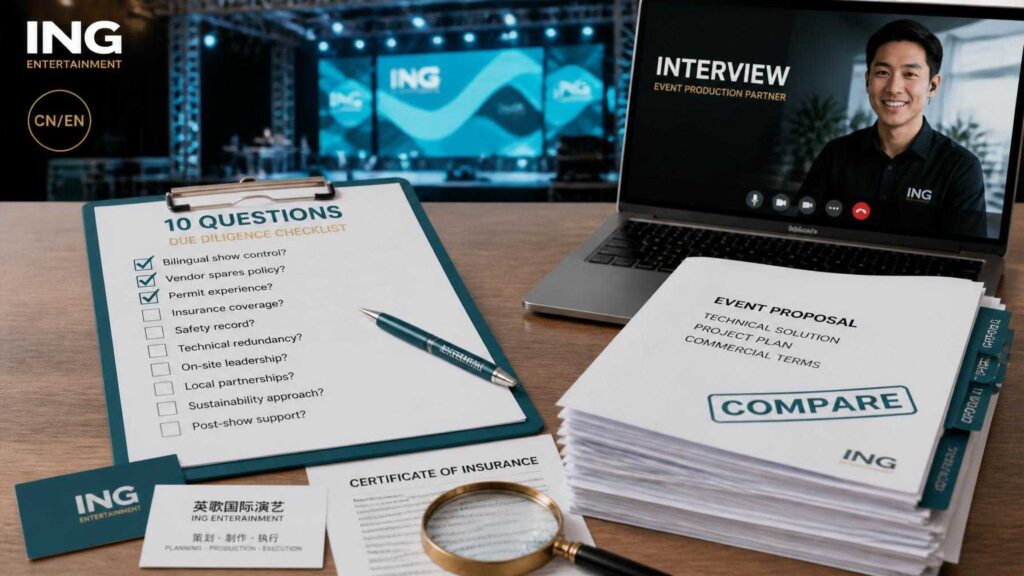
Table of Contents
- Do You Provide Bilingual Show Control (CN/EN Cue Sheets, Stage Managers, Comms)?
- How Do You Vet Vendors? What’s Your Spares Policy?
- What Is Your Experience with Permits and Compliance in This City?
- How Do You Handle Contingencies? (A/B/C/D Show Versions)
- Can You Provide Broadcast References from Similar Events?
- How Do You Cast Talent? Do You Have Your Own Performers?
- What Is Your Process for Cultural Adaptation?
- How Do You Integrate Social Media and Content Capture?
- What Is Included in Your Quote? What Are Common Hidden Costs?
- Can You Provide Client References (Ideally from My Industry)?
Bonus: Red Flags to Watch For
Conclusion: Why ING Entertainment Answers “Yes” to All 10
Question 1: Do You Provide Bilingual Show Control (CN/EN Cue Sheets, Stage Managers, Comms)?
Why this matters: China’s local crews are skilled, but most speak limited English. Under pressure—during a live show with hundreds of cues—misunderstandings are dangerous. Bilingual documentation and personnel are non-negotiable.
What a good answer sounds like:
- “Yes. We provide mirrored CN/EN cue sheets with timecode for every department.”
- “Our stage managers and technical directors are bilingual and have worked with international clients.”
- “We use bilingual comms protocols with clear channel mapping and code words.”
- “We can show you samples from recent productions.”
What a red flag sounds like:
- “Our local crew understands basic English.”
- “We don’t usually do bilingual cue sheets, but we can try.”
- “The venue provides translators if needed.”
ING’s answer: Bilingual show control is standard on every international production. We deliver mirrored CN/EN cue sheets, shot lists, run-of-show documents, and comms protocols. Our producers, stage managers, and technical directors are fluent in both languages—no interpreters needed.
Question 2: How Do You Vet Vendors? What’s Your Spares Policy?
Why this matters: China has thousands of equipment vendors. Quality varies dramatically. Some use older gear, lack backups, or have no broadcast references. When an LED panel fails or a microphone drops out, spares are the difference between a quick fix and a show-stopping disaster.
What a good answer sounds like:
- “We maintain relationships with pre-vetted vendors in every major city.”
- “We inspect equipment before every show—LED batches, audio consoles, lighting fixtures.”
- “Our contracts require spares: backup media servers, spare fixtures, redundant power paths.”
- “We carry our own backup systems for critical items (playback, comms).”
What a red flag sounds like:
- “We work with whoever has the best price.”
- “We haven’t had issues with equipment failing.”
- “The vendor says they have backups if needed.”
ING’s answer: We maintain relationships with proven vendors across China. Before every show, we inspect gear, verify spares, and ensure timecode integration. Our contracts require redundant systems: mirrored media servers, backup consoles, spare fixtures, and spare comms. We don’t hope nothing breaks—we plan for it.
Question 3: What Is Your Experience with Permits and Compliance in This City?
Why this matters: Permit timelines, requirements, and bureaus vary by city. Shanghai differs from Beijing, which differs from Chengdu. A company without local compliance experience can cause delays—or cancellations.
What a good answer sounds like:
- “We have produced events in [your city] and know the specific bureaus.”
- “We handle the full compliance pathway: documentation, submissions, follow-ups.”
- “We typically budget 10-20 working days for permits, longer for outdoor or drone events.”
- “We can share a compliance checklist from a recent similar event.”
What a red flag sounds like:
- “The client usually handles permits.”
- “Every city is pretty much the same.”
- “We haven’t done an event in [city] but it should be fine.”
ING’s answer: Based in Zhengzhou but producing nationwide, we have deep permit experience in Shanghai, Beijing, Chengdu, Wuhan, and provincial capitals. We manage the full compliance pathway—preparing bilingual documentation, submitting to the correct bureaus, and handling follow-ups—so you stay focused on creative.
Question 4: How Do You Handle Contingencies? (A/B/C/D Show Versions)
Why this matters: Live events are unpredictable. Pyro gets denied. A performer gets sick. Rain moves you indoors. Time gets cut. Companies without contingency plans scramble. Professionals have versions ready.
What a good answer sounds like:
- “We build A/B/C/D show variants during rehearsals.”
- “A = full show. B = no pyro/no haze. C = reduced cast. D = camera-first macro geometry.”
- “We rehearse all versions so the team can pivot without panic.”
- “Our run-of-show includes contingency triggers and decision-makers.”
What a red flag sounds like:
- “We’ve never had to change a show last minute.”
- “We’ll figure it out if something happens.”
- “The client decides on the day.”
ING’s answer: Every ING show is actually a family of shows. We build and rehearse A/B/C/D variants so the team can pivot instantly when conditions change. Our run-of-show documents include contingency triggers, decision-makers, and communication protocols. We don’t panic—we execute the backup plan.
Question 5: Can You Provide Broadcast References from Similar Events?
Why this matters: Anyone can claim experience. Broadcast references prove it. A production company that has worked with TV networks, major brands, and large festivals has been vetted by others.
What a good answer sounds like:
- “Yes. Here are three recent clients with contact information.”
- “We’ve produced for [specific networks/brands/events].”
- “We can share video links from broadcast recordings.”
- “Our references are from events similar to yours in scale and type.”
What a red flag sounds like:
- “We have NDAs and can’t share references.”
- “Our clients prefer to remain confidential.”
- “We can share photos but not contact information.”
ING’s answer: We proudly share broadcast references from Henan Television, Lynk & Co, Chery Auto, Zhengzhou CoolPlay EDM Festival, Central China Live, and other satisfied clients. We’ll provide contact information and video links from events similar to yours.
Question 6: How Do You Cast Talent? Do You Have Your Own Performers?
Why this matters: Some companies subcontract everything, marking up external talent without adding value. Companies with their own performers (like ING Girls) offer better coordination, lower costs, and consistent quality.
What a good answer sounds like:
- “We have our own roster of performers, including [specific acts].”
- “We cast by function—energy carriers, precision anchors, character movers.”
- “We also work with trusted heritage acts (lion dance, Bian Lian, folk ensembles).”
- “Our casting process includes auditions, briefings, and rehearsals.”
What a red flag sounds like:
- “We find performers on [platform] as needed.”
- “We don’t have our own talent, but we know people.”
- “The client is responsible for casting.”
ING’s answer: ING Entertainment has a 52-member troupe including ING Girls (main vocal, vice vocal, main dancer, rapper configurations). We also maintain relationships with premier heritage acts, specialty performers, and contemporary crews. Our casting is integrated with choreography and show control—one team, seamless execution.
Question 7: What Is Your Process for Cultural Adaptation?
Why this matters: What works in London or Los Angeles may not resonate in Shanghai. Chinese audiences have distinct expectations around harmony, face, collectivism, and authenticity. A production company that ignores cultural adaptation risks alienating audiences.
What a good answer sounds like:
- “We review every creative element through a cultural lens.”
- “We have Chinese creative directors and cultural consultants on staff.”
- “We adapt movement vocabulary, music, humor, and storytelling for local audiences.”
- “We can share examples of how we adapted international creative for China.”
What a red flag sounds like:
- “Good performances are universal.”
- “We add a lion dance if the client wants.”
- “Chinese audiences like the same things as Western audiences.”
ING’s answer: Cultural adaptation is central to our process. We review every concept, music edit, choreography, and wardrobe choice for Chinese audience resonance. Our team includes Chinese creative directors who ensure authenticity without cliché. We don’t guess—we know what lands.
Question 8: How Do You Integrate Social Media and Content Capture?
Why this matters: Modern events don’t end when the curtain falls. They live on Douyin, Xiaohongshu, Weibo, Bilibili, and Kuaishou. A production company that doesn’t plan for social capture misses half the value.
What a good answer sounds like:
- “We design ‘press frames’—specific moments held for photography.”
- “We position vertical cameras for Douyin/Reels capture.”
- “We coordinate timing with client social teams for real-time posting.”
- “We capture B-roll throughout rehearsals and show day for post-event content.”
What a red flag sounds like:
- “The client handles social media.”
- “We can provide photos after the event.”
- “We haven’t thought about vertical capture.”
ING’s answer: We design social moments at every stage—pre-event teasers, show-day capture, post-event content. We choreograph press holds, position vertical cameras, and coordinate with client social teams for real-time posting. Your event becomes a content ecosystem, not just a live moment.
Question 9: What Is Included in Your Quote? What Are Common Hidden Costs?
Why this matters: Low bids often hide exclusions. Overtime, spares, permits, insurance, catering, and last-minute changes can double the final invoice. Transparent companies disclose everything upfront.
What a good answer sounds like:
- “Here is a detailed line-item quote with every cost category.”
- “We explicitly state what is included AND what is not included.”
- “We identify common hidden costs (overtime, spares, permits, contingencies) upfront.”
- “We recommend a 10-15% contingency line item for surprises.”
What a red flag sounds like:
- “We give a flat price—don’t worry about the details.”
- “Extras are rare, but we’ll let you know if they come up.”
- “Permits and insurance are usually included (but check the fine print).”
ING’s answer: Our quotes are transparent line-item documents. We clearly state what’s included—and what isn’t. We highlight common hidden costs (overtime, spares, permits, contingencies) before you sign. No surprises. No hidden fees. Just honest pricing.
Question 10: Can You Provide Client References (Ideally from My Industry)?
Why this matters: The ultimate test. A production company should be willing to let you speak with past clients—especially from your industry (automotive, luxury, tech, festivals, TV).
What a good answer sounds like:
- “Absolutely. Here are three clients from [your industry].”
- “We’ll provide contact information and suggest specific questions to ask them.”
- “We can also arrange a call with a past client if you prefer.”
- “Our references include both happy clients and those who challenged us (so you get the full picture).”
What a red flag sounds like:
- “We have NDAs.”
- “Our clients are too busy.”
- “You can read our online reviews instead.”
ING’s answer: We’re proud of our client relationships. We’ll connect you with past clients from your industry—automotive, luxury, tech, festivals, TV—who can speak to our quality, reliability, and professionalism. No NDAs hiding the truth.
Bonus: Red Flags to Watch For
| Red Flag | Why It’s a Problem |
|---|---|
| Can’t provide bilingual cue sheets | Communication failures during pressure moments |
| No spares policy | One equipment failure = compromised show |
| “We’ve never had problems” | Untested or inexperienced |
| Vague about permits | Delays, cancellations, or legal issues |
| No broadcast references | May not understand multicam, timecode, or broadcast standards |
| Subcontracts everything | Markups, coordination gaps, no direct quality control |
| Unwilling to share client contacts | Hiding something |
Why ING Entertainment Answers “Yes” to All 10 Questions
| Question | ING’s Answer |
|---|---|
| Bilingual show control? | Yes. CN/EN cue sheets, stage managers, comms as standard. |
| Vetted vendors + spares? | Yes. Pre-vetted vendors, spares in contracts, redundant systems. |
| Permit experience? | Yes. Nationwide, including Shanghai, Beijing, Chengdu, Wuhan. |
| Contingency plans? | Yes. A/B/C/D show variants rehearsed and ready. |
| Broadcast references? | Yes. Henan TV, Lynk & Co, Chery Auto, festivals, concerts. |
| Own talent roster? | Yes. 52-member troupe + ING Girls + heritage acts. |
| Cultural adaptation? | Yes. Chinese creative directors on staff. |
| Social media integration? | Yes. Press frames, vertical capture, B-roll, timing coordination. |
| Transparent pricing? | Yes. Line-item quotes, hidden costs disclosed upfront. |
| Client references? | Yes. From your industry, with contact information. |
Ready to Hire Your China Event Partner?
You now have 10 questions to evaluate any production company. Use them. Ask tough questions. Check references.
And when you’re ready to work with a partner who answers “yes” to every question—with broadcast-ready discipline, bilingual precision, and a track record of success across China—ING Entertainment is here.